We use cookies to ensure that we give you the best experience on our website. Click continue if you're happy to receive all cookies from awesomecomms.com.
The artist, Banksy, has redesigned one of his iconic images in tribute to the people of Syria, on the third anniversary of the war that is raging around them.
Visit the withsyria.com website and watch the video that he made, voiced by Idris Elba, then follow the links to show your support.
I love Google’s current Doodle, reminding the world that the Olympic Charter states that ‘The practice of sport is a human right’ and using the colours of the rainbow flag. Perfectly timed, as the Winter Olympics kick off in Sochi – against the backdrop of Russia’s appalling anti-gay laws.
The sad death of a man who really did change a part of the world. Glad that he lived to see the impact he made and how much he was loved and admired. His Long Walk is now truly over. RIP Mr Mandela.
There’ll be sooo much coverage around this. I just wanted to post a couple of the ways that organisations I know have marked it.
This is a documentary that’s been crying out to be made for decades. A tribute to the amazing backing singers from America who created the sound on many of the records we all know and love. From Ike and Tina Turner, Stevie Wonder, Michael Jackson, Whitney Houston and Luther Vandross; to Lou Reed, Joe Cocker, Sting, The Rolling Stones, Bruce Springsteen, Talking Heads and David Bowie – to name just a few – it’s truly mind blowing how many artists this elite, small number of singers have worked with over the years, to elevate their songs from being ‘good’ to being a ‘classic’. This documentary focuses on the singers working with high profile artists. But while we’re on the subject, let’s take a moment to give a nod to the many, many brilliant backing singers working with more low-key musicians, then and now. Without a single pun intended, these people are the unsung heroes of music.
With glowing and insightful interviews from some of the artists named above – as well, for some reason, Betty Midler – plus the singers themselves, Twenty Feet From Stardom traces the history and next steps of the men and women that formed the soundtrack of many of our lives without us even realising it. Inescapably intertwined in this documentary is a look at the influence that the music producer, Phil Spector, had on the industry and the way that he used that to control the people he worked with.
As is still often the case nowadays, the black backing singers of the 1960s all came from a gospel background. They were used to the pastor singing to lead the church congregation in praise and then they and their fellow choir members would find their vocal place in a harmony, in response. When they were eventually given the opportunity to support a recording artist, it really wasn’t a huge stretch for them.
This film is full of wonderful characters. Like Dr Mable John, a former backing singer – including being a ‘Raelette’, supporting Ray Charles – and solo artist – The Supremes were HER backing singers once! – and now a pastor, she says: “I see a kid doing the slide. He thinks he’s got it from James Brown. I tell him: “Oh child, that came from one of my ministers!” “
The first black backing singers were Darlene Love and The Blossoms. Proceeded by prim, white women, secretly nicknamed ‘The Readers’ because they could only sing what was put in front of them on sheet paper, while they stiffly swayed to the music. The arrival of The Blossoms, with their raw energy, powerful voices and grasp and encapsulation of the music blew everyone away.
Lynn Mabry – singer with Sly and the Family Stone, P-Funk, Parliament and one of the two original ‘Brides of Funkenstein’ – tells us: “When Lou Reed wrote that line that made many people uncomfortable: ‘And the coloured girls sing….’ he was actually acknowledging the backing singers and the connection to people that they brought to the music.”
The natural talent we see in this film brought to mind the manufactured nonsense that we’re drowning in nowadays, especially when we see a clip of Luther Vandross putting together his group of backing singers to create an ensemble that brought the best out of each of them and the music overall. 1 Direction or Girls Aloud wouldn’t even know where to start!
20 Feet From Stardom: Judith, Merry & the Waters Brother
However, it was a time when there was only room for one or two black stars – and the world already had Aretha Franklin and Dina Ross and Tina Turner. So, despite singing on so many records and having such amazing voices, solo success sadly escaped most of these singers and often they didn’t even get the credit that they rightly deserved. Darlene Love ‘ghosted’ for people, sometimes knowingly singing on their behalf but other times conned into doing so. Claudia Lennear, one of Ike and Tina Turner’s ‘Ikettes’, was another who tried. She describes the Ikettes as being “the first action figures of R&B”. Mick Jagger talks, very fondly, about working with her. And when you see how HOT she was back then, you’re not surprised. However, despite getting a record deal hers was another solo career that didn’t take off.
We meet the Waters Family: two sisters and a brother who helped create everything from Patti LeBelle’s “Bad Girls” to Michael Jackson’s “Thriller”, who are still so in demand that they’ve even done vocals for the films The Lion King and Avatar. They clearly love their life, whilst being acutely aware that the type of success they had prevented them pursuing their intended career as an independent group.
Claudia Lennear record cover
Just when work was starting to slow down for some in America, British rock music came onto the scene. Our musicians wanted to sound black, so they brought in black singers. We’re told that: “Everyone was telling us to bring everything down, so when the rock and roll world came and said ‘no, bring everything up’, it saved us.”
One of this film’s many wonderful gems comes from Merry Clayton recounting the night she was at home, pregnant, in her pyjamas with curlers in her hair, when she got a call saying “the Rolling something were in town from England, would she come into the studio”. A car picked her up and she went in with a fur coat over her p-js and a Chanel scarf over her curlers… Mick Jagger takes up the story in a separate interview. He says there was a bit in their new song about rape and murder and they wanted a woman to sign it. The song turned out to be “Gimme Shelter”. And in the studio at 2am, pregnant Merry kicked vocal arse.
We also meet the new generation of backing singers, like Lisa Fischer, who has been the lead singer on The Rolling Stones’ tour since 1989, singing those lyrics that Merry Clayton brought to life, amongst many other famous songs. As well as Judith Hill, who was due to perform with Michael Jackson at his comeback tour and instead sang “We Are The World” at his memorial. Judith is now trying to carve a solo career for herself, conscious of the hurdles faced by her predecessors.
There is so much great stuff in this film that it’s really difficult to not just keep writing. It’s a huge shame that it’s on for such a limited run during the London Film Festival. However, you still have two more opportunities to see it, this weekend, at the Rich Mix at 3.30pm or Odeon West End at 12.30pm on Sunday (you have to book via the BFI website, or in person at the cinemas) and hopefully, it will get a full release next year. I can’t recommend it enough.
This is one for the collection. A piece of musical history. I can’t wait for the DVD to come out. I won’t just be getting one for myself but also for my mum and all my aunties!
I’m going to put it out there from the start. This film blew me away. I loved it. Now, I’m not one of your die-hard, Danielle Radcliffe fans. He seems like an nice enough young man but I didn’t read any of the Harry Potter books, I’ve never really seen any of the movies and the little bits that I’ve caught have been accidental – at someone’s house when their kids have been watching. I’ve nothing against it. It just isn’t my thing. (Although, I do really like J. K. Rowling, ‘as a person’.) I’m aware that Mr Radcliffe has been going out of his way to choose films that would differentiate him from his Hogwarts character. Understandable, I’d thought. Good for him. But I wasn’t particularly interested in his acting career. However, he is undoubtedly very, very good in this film. Very good indeed. As are his main co-stars, with Dane DeHaan deserving a mention in particular. However, they are ALL very good.
Kill Your Darlings is the true story of the poet Allen Ginsberg’s time at Columbia University in New York, which ended up with him being embroiled in a murder. With a poet for a father, the young Ginsberg was confident with literature but otherwise very quietly determined and shy. From a poor Jewish background and with a mother who was mentally ill, it’s a leap for him to apply to university and he goes full of hope and ambition.
Ginsberg soon discovers that university is full of bigotry and restrictions – both in terms of how lecturers and most other pupils think and in how they are allowed to express themselves. To the extent that work of writers perceived as being corruptive – such as James Joyce and Henry Miller – are denounced and their books kept under lock and key. Everything changes when Ginsberg meets Lucien Carr, an idealistic senior poetry student with maverick tendencies. Lucien introduces Allen to the ‘other’ New York – the infamous Greenwich Village, jazz clubs and alternative friends, such as the legendary drug taking William Burroughs and ladies man Jack Kerouac. Against a backdrop of excessive drinking, drug taking, sexual awakening and partying – as well as some great music – the four of them declare war on the staid, traditional old order and vow to make a permanent place for themselves in history by setting up The New Visions – a group and way of thinking that would later become known as The Beat Generation. A new movement is born and Ginsberg’s original ambitions for university and life fall by the wayside.
Core to this story and amidst all of their disruptive – and self-destructive behaviour – is the constant and slightly unnerving presence of David Kammerer, Lucien’s ‘mentor’. As the film progresses we discover the significance of his presence and the long term impact that he will have on all of their lives.
A nice little writing touch is the way that characters are introduced – an additional scriptwriting challenge for a film where the main characters are so famous. The writers, Austin Bunn and John Krokidas, had me so engrossed in the plot that I didn’t immediately realise the identify of each new character as I met them. Which made it all the more satisfying each time the full reveal came.
One of the great side effects of this film is the insight it gives into William Burroughs and Jack Kérouac’s lives, as well as into Ginsberg’s underlying moral code which, in the end, he couldn’t deny.
As I said at the start, Kill your Darlings blew me away. Although, perhaps not for the reasons that you might assume. When it was over, I needed to sit for a while and ruminate over what I’d just seen and its implications, in terms of what the film’s creation and distribution must mean for those connected to this story and their families.
The film very fittingly plays out to the Libertines’ “don’t look into the sun” – a song written and performed by two young male friends, whose relationship turned sour against a backdrop of excess. I totally recommend that you go to see this. And do hang around for the credits at the end, as you’ll see some wonderful original photographs of The Beat Generation at their prime.
[Watched as part of the BFI London a Film Festival 2013]
Social Media Week may only have been going for a couple of years but it’s already an important and regular fixture in my calendar. An unbeatable way to hear from and connect with some of the most important players in the social media landscape and many of my communications colleagues and peers. From 23rd – 27th September 2013, eight cities around the world participated, bringing together people of all levels of experience to discuss and demonstrate best practice and discuss the future.
When else do you get chance to hear first hand from Heads of Departments and the digital leads of organisations such as Facebook, Google, Twitter, Spotify, Pinterest, Island Records, Defected Records, Big Talk Productions and Total Film, as well as find out what some of the newer players, such Glipho and MixCloud are doing.
It’s a firm fixture in my diary and I’m already looking forward to next year.
Profile on little old me, at Social Media Week London 2013
(H/T to Mark Davies for reminding me of this great Mr Fingers remix from the 90s! We’ve come a long, long way. Yet, sadly, the recent murder of the 19-year old boy, Trayvon Martin, in the US, and the subsequent ‘not guilty’ verdict against the man who killed him, reminds me that, despite America having a black president, this is still a far away dream for many. Even sadder is that to some others, such equal and harmonious living would feel like a nightmare.)
Somerset House’s (SH) Film 4 season got off to a flying start last night. Over the years, they’ve always managed to snag at least one great new film to premier there, and 2013 is proving to be no different. Despite my aspirations at being intellectual and highbrow, the truth is that one of my favourites was the premier of Knocked Up a few years ago, which had me laughing out loud in embarrassment as much as joy and today is still a very beloved film to me.
About Time – the new film by the lovely Richard Curtis, which if you believe the previews is also his last rom-com, EVER – had me feeling pretty much the same way. A story about an awkward young man who, on his 21st birthday, is told by his dad (the wonderful Bill Nighy) that he is able to travel through time. It’s extremely funny, quite close to the bone in some places, a little bit cheesy, very sad in parts (once again, I blubbed, quite a lot) and generally just a great film, with a new take on a clever concept. I thoroughly enjoyed every moment of watching it and have no doubt that it will become part of my film collection in the same way that Knocked Up has (whereas, I’m afraid, Notting Hill is more a watch-when-it’s-on-telly kind of movie.)
Getting settled into screenings at Somerset House is always a bit of a palaver, mainly due to the free-for-all on its cobbled courtyard floor where you sit and the long wait between the doors opening at 6pm and the film starting at 9pm-ish (rest assured – for an easy life and most comfort, get there as early as possible). But it’s a beautiful setting, so definitely worth the hassle.
The great DJ definitely took the edge off things and any bickering between my neighbours died off immediately, when SH’s lovely director came on stage and, to our surprise and delight, he introduced the wonderful Richard Curtis, who in turn introduced the cast (including Bill Nighy!) after giving the kind of speech that left you in no doubt of his natural comic talents. If that isn’t a great way to start a movie, I don’t know what is.
Overall, just a great night. Can’t wait to see what happens this evening, at Whatever Happened to Baby Jane!
I’m very excited to be a delegate at the Edinburgh International Film Festival 2013 (EIFF) – and even happier that the first event I’ve been to was a very clever, well made and thought-provoking short film. ‘Dr Easy’ tells the story of a medical robot that is sent into a derelict building to treat an armed man who is holed up in the aftermath of a police shoot out. It’s a fascinating conversation-starting film, making you think about the role robots will be able to play in our lives in the future. After the film, there was a panel session with the creators, Shynola – a well-respected three-man production company based in Hackney, East London, who usually specialise in music videos for the likes of Coldplay and Radiohead – alongside someone from Warp Films, who they took their ‘Dr Easy’ script to, for help making it, and someone from Film4.0, who Warp have a ‘First Look’ deal with and took the script to, in the hope of getting funding.
The short film is based on a the opening chapter of a book by Matthew De Abaitua called, The Red Men. It’s intended as a trial run for their full length feature film, based on the entire book. The EIFF session gave us a great insight into both the development process – including showing us images from the pitching document that they took to Film4.0 – and the making of a film that combines live action with visual effects. Everything from having to shoot blank walls, repeatedly and from different angles, so that they had the background they needed to put the robot against, to the thought process behind getting the robot just right. (They wanted to move away from the stereotypical robots that we usually see in films, who tend to be rusty for no good reason and have evil eyes because they’re about to go on a killing spree. This robot needs to be not just clean but wipe-downable, as it’s going to to getting blood on it, from patients rather than from victims. It needs to be robust and strong – but not intimidating, so that humans will accept help, including medicine and injections. Its facial features need to be neutral enough to deliver both good and bad news, whilst never seeming judgmental. Brilliant stuff!) This isn’t a sci-fi film, as such. It’s a short about the way humans connect and as such it will appeal to people across the spectrum. I really enjoyed it and I look forward to seeing the feature.
An hour after this EIFF session – which was also its worldwide launch – the film went live online. Take a look for yourself and let me know what you think.
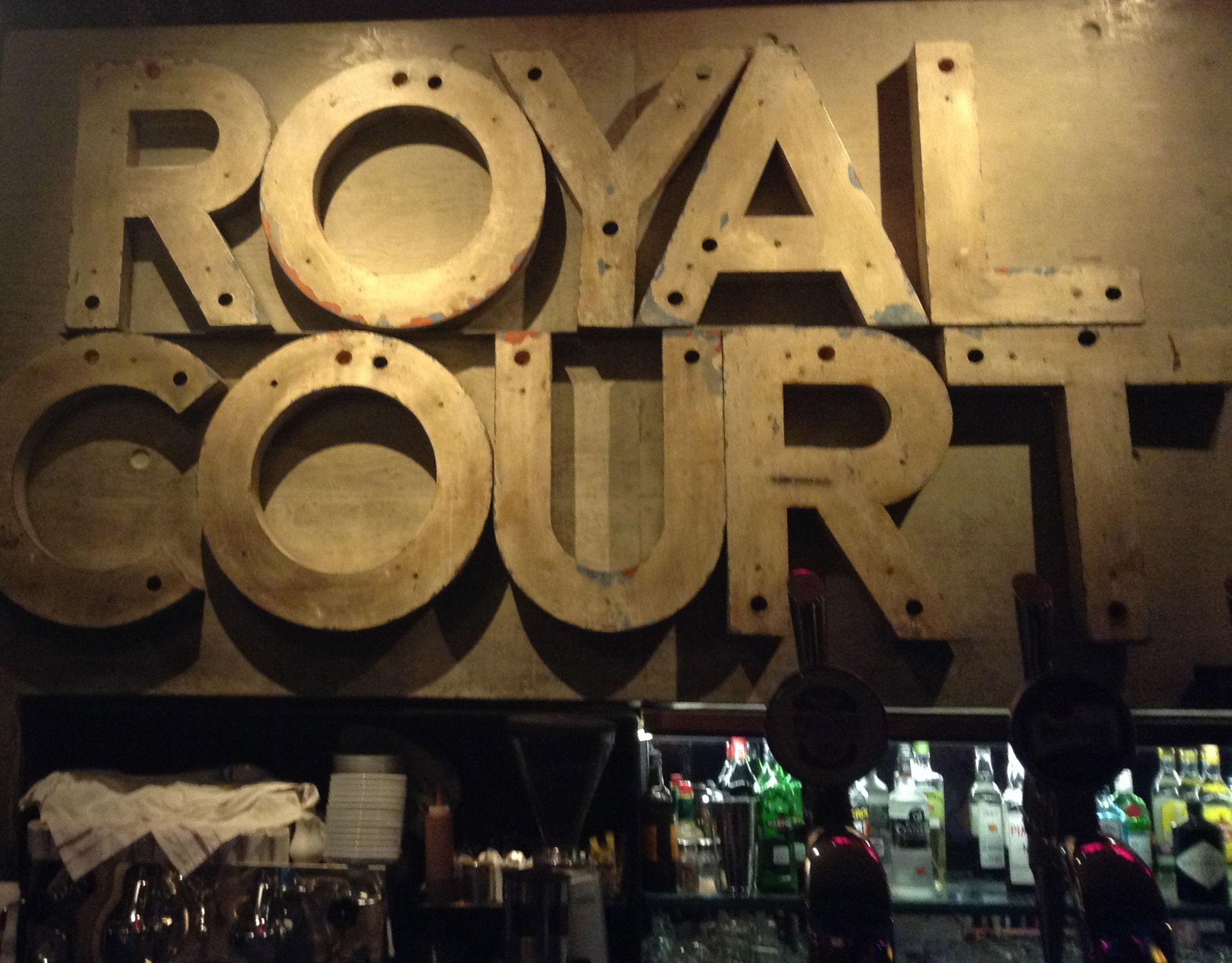
I love the theatre and go quite often, yet somehow I’d never made it to the legendary Royal Court Theatre – until last night. It’s long been on my To Do list, as I’ve read a lot of great things about the support they give to new writers. My curiosity was peaked further during the recent Sundance London film festival, when I found out that one of the great shorts I’d seen was based on a play that the screenwriter had stumbled upon at the Royal Court.
To me, conversations about this seemingly-hallowed ground of bubbling creativity, always conjured up images of a very grand space – a cross between the Royal Opera House and the open air amphitheatre in Regents Park. So I was very excited to be invited to the first night of its ‘Open Court‘ season, last night – finally, I would get to experience the great Royal Court for myself!
Open Court is the brainchild of the new artistic director, Vicky Featherstone, who describes it as her ‘handing over the building to the playwrights’, in order to capture what the Royal Court is all about. The writers and the audience. All of the plays, ideas and events over the next six weeks (10 June – 20 July) have been chosen and suggested by a group of over 140 writers.
Open Court is jam-packed with shows and events – from the Weekly Rep, where a new play will be produced every week over those six weeks, and performed by the same cast of characters; to a mini-soap opera being produced in conjunction with one of their partner organisations, the Bussey Building in Peckham, which will be performed by local residents in front of a studio audience and live streamed. Last night, I saw the first Weekly Rep – The President Has Come To See You – a quirky comedy set in the country of Georgia, with a couple of stand-out acting performances and some clever writing and directing. That, coupled with the Open Court launch party that followed, saw Royal Court packed to the rafters, with young and old alike, in a much more accessible, modern and relaxed environment than I’d imagined it would be.
As my friend Catrin and I enjoyed the free vodkas provided by one of the event sponsors, we found ourselves next to a group of lovely senior citizens. Chatting to them revealed that they were from the Open Court’s ‘Eighty and Over’ strand. After sending in examples of their writing, they had each won one of the limited places to develop a play as part of the season. So they had spent every Wednesday for the last four weeks workshopping script ideas and writing and their resulting play, The Big Idea, will be on next Friday, 21st June. One 84 year old gentleman used to be a furniture restorer and didn’t start writing until he retired four years ago, at 80. Amazing!
Despite this being my first time at the Royal Court, even I can feel that Vicky Featherstone has brought a new lease of life to the organisation. Since she joined in January, they’ve already done their first live stream of a play, with more to come during Open Court, and beyond no doubt. Her speech was short but perfectly formed, conveying her inclusive attitude, as well as her passion and appreciation for the arts and for everyone involved in the event – from every member of staff, to the writers – many of whom she could name check – to the sponsors. And the nod to the sponsors was genuine, rather than perfunctory as it often is. For, as she pointed out, with so many cuts in the arts, without generous private sponsors, these shows really wouldn’t go on.
A great start to what looks like a great season at the Royal Court, polished off nicely by a DJ playing brilliant tunes. Actors, writers, audience members, sponsors and Royal Court employees all took to the dance floor for a well deserved boogie. I don’t think I could have had a better introduction to the Royal Court Theatre. There is absolutely no doubt that I will be back there soon.