Persepolis, at the BFI
Posted on by Janet Awe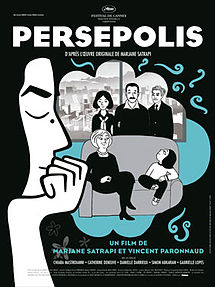
Poster for Persepolis
Two of the wonderful things about films are the strong emotions that they can evoke and the different worlds that they can open up to you. Persepolis demonstrates that in spades. This animated French movie provides a sharp, witty and ultimately heartbreaking insight into life inside Irania. Based on the writer and director, Marjane Satrapi’s, own childhood memoirs, living through a revolution in the late 70s, a war in the 80s and ongoing oppression in the 90s, it’s the story of one little girl, called Marjane, and her family who want to live a ‘normal’ life, free from the dictatorship and fighting that rules their land. They respect their religion but are also modern and forward-thinking, so their oppression is visibly stiffling.
We see the nightmare of trying to live every day life in an environment peppered with bullies, bombs and bullets. And how, during the 70s, the rules being imposed on women got increasingly stricter, whilst respect for them diminished in equal measure. We see mothers despair for their teenage boys who are being brainwashed into martyrdom during their school lessons and for the freedoms that they themselves enjoyed as children and teenagers, which are now firmly curtailed. Any signs of Western behaviour or taste – from music and make-up, to alcohol and dancing – are seen as decadent and disrespectful, and therefore strictly forbidden.
We follow Marjane as she grows up and, like most young people, tries to make sense of her life. But the usual teenage angst and confusion associated with finding yourself and expressing your individuality as you come of age are heavily curtailed by the political backdrop and the mental scars that she carries.
Though extremely sad, Marjane’s story is one of hope. Time and time again during the film, we see her stand up for herself and for what’s right. It feels like her film, Persepolis, is an extension of that. Making it – and finding such a wide audience to share her story with – is a huge achievement. And something, that I’m sure couldn’t have happened if she was still living in Iran.
The saddest part is that not enough has changed in the world.
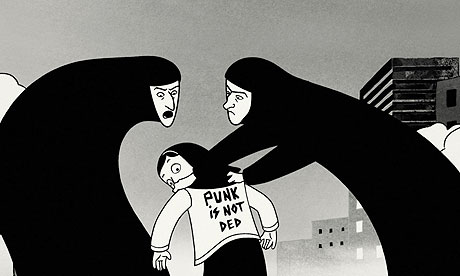
Martje is reprimanded for Western clothes
In the film, when Marjane is at school during the mid-80s, a teachers tells her class that the country no longer has political prisoners. Marjane confronts the teacher, asking why she’s lying to them when her uncle had been a political prisoner and was recently killed in jail. She’s reprimanded for talking back and the school call her parents. But when her parents are told, their main concern is for Marjane’s safety, as they’re worried that one day her outspoken nature will get her killed. So they send away her to school in Austria. Watching that scene brought to mind Malala Yousafzai, the 14 year old girl who was shot in the head by the Taliban only last month for championing education for girls and highlighting Taliban atrocities.
It’s no surprise that Persepolis won the Jury’s Prize at the 2007 Cannes Film Festival. Equally, it’s no surprise that it lost out on the Oscar to – of all things – Ratatouille. I can imagine Hollywood wanting to keep at arms length from such a powerful, and undoubtedly, controversial film.
Persepolis is wonderfully observed and scripted and the animation is fabulous. Plus a good dose of humour gives it a very funny and much-needed light touch. Despite the sad issues and Iran’s complex history, it’s very easy to watch. Essentially, it’s a story about a little girl growing up, finding her way in life and falling in and out of love, under very difficult circumstances. It’s a really great film and I highly recommend it.
And in case you’re wondering, as I was, Persepolis gets it’s name from an area in Iran.